
Veterinary advice should be sought from your local veterinarian before applying any treatment or vaccine. Not sure who to use? Look up veterinarians who specialize in poultry using our directory listing. Find me a Vet
Other Names: Thread Worms, Hairworm Infection, Capillara, Small Roundworms
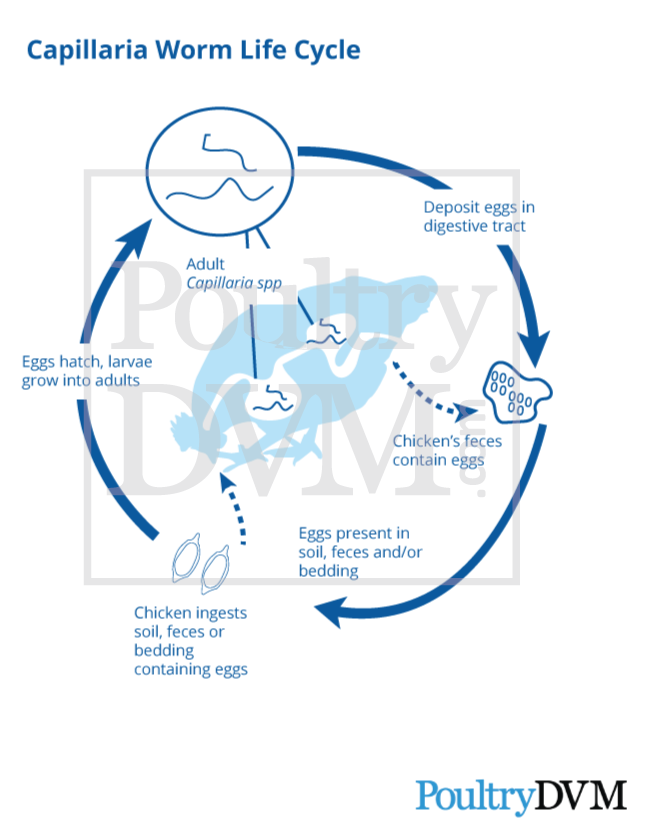
| Nematode species | Where Found | Intermediate Host | Definitive Hosts |
|---|---|---|---|
| Capillaria annuata | Esophagus, crop | Earthworm | Chicken, turkey, guinea fowl, partridge, pheasant, quail, goose, grouse |
| C. anatis | Small intestine, cecum, cloaca | None | Chicken, turkey, partridge, pheasant, goose, duck |
| C. bursata | Small intestine | Earthworm | Chicken, turkey, pheasant, goose |
| C. caudinflata | Small intestine | Earthworm | Chicken, turkey, guinea fowl, partridge, pheasant, quail, goose, grouse, duck, pigeon |
| C. contorta | Esophagus, crop, mouth | None or earthworm | Chicken, turkey, guinea fowl, partridge, pheasant, quail, duck |
| C. obsignata | Small intestine | None | Chicken, turkey, guinea fowl, quail, pigeon, goose |
| Name | Summary | |
|---|---|---|
| Albendazole (Valbazen) | 5-50 mg/kg bw PO | B Speer; Tucker, C. A., et al., 2007; Yazwinski, T. A., et al., 2013 |
| Fenbendazole | According to manufacturer label | B Speer; A Soudkolaei et al., 2021, |
| Ivermectin | 0.2-0.4 mg/kg bw PO, repeat in 2 weeks | X Xu 2019; B Speer; S Khalid 2017; C Angel 2018 |
| Piperazine | Piperazine is no longer available in the United States. | |
| Garlic | F Velkers et al., 2011 | |
| Turmeric (Curcuma longa) | Added to feed | Alrubaie Al, 2015 |
| Papaya (Carica papaya) | Added to feed | Feroza et al., 2017; Dakpogan et al., 2017 |
| Pumpkin seeds | Added to diet | T Feitosa et al., 2013 |
© 2026 PoultryDVM All Rights Reserved.